New Kashmir Gold Granite: Origin, Specifications, Uses and Export Guide

New Kashmir Gold granite is a warm golden-yellow natural stone from the Madurai region of Tamil Nadu, India, with grey and black mineral flow and burgundy garnet specks. It is the current production version of the classic Kashmir Gold granite. It is used for countertops, vanity tops, flooring and wall cladding, and is exported as slabs, tiles and cut-to-size pieces.
New Kashmir Gold Granite at a Glance
| Attribute | Details |
|---|---|
| Trade names | New Kashmir Gold, Kashmir Gold, Cashmere Gold, Kashmir Gold Granite |
| Origin | Melur–Madurai belt, Tamil Nadu, South India |
| Stone type | Sold commercially as granite; geologically a garnet-bearing granulite |
| Colour | Golden-yellow to beige base with grey/black flow and burgundy garnets |
| Pattern | Moving, wavy pattern that varies by block |
| Finishes | Polished, honed, leathered, flamed, brushed, sandblasted |
| Thickness | 2 cm and 3 cm slabs; 1–2 cm tiles; custom thickness on request |
| Best uses | Kitchen countertops, vanity tops, interior flooring, wall cladding, stairs |
| Exterior suitability | Yes, with appropriate finish and sealing |
What Is New Kashmir Gold Granite?
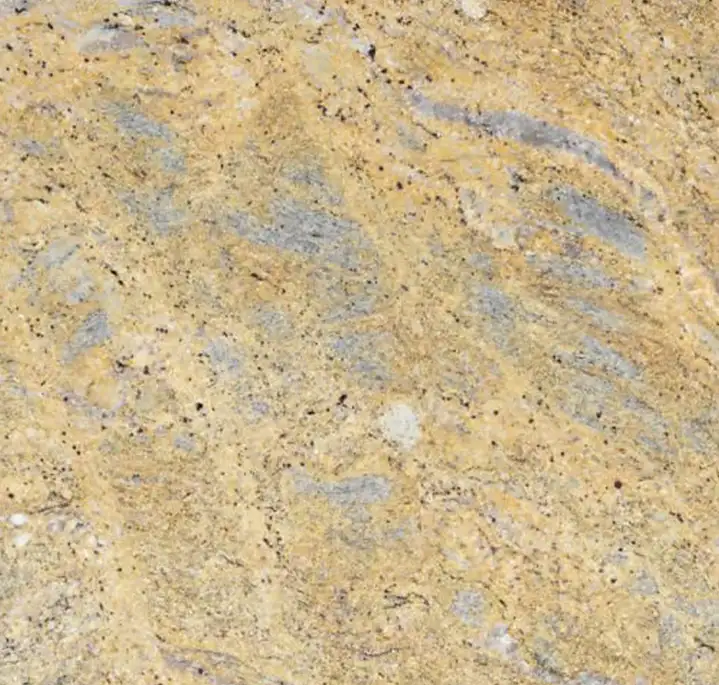
New Kashmir Gold granite is one of India’s most widely exported gold-toned natural stones. It has a light golden-to-cream background, soft grey and black mineral veins that flow across the surface, and scattered deep-red to burgundy garnet crystals. Together these create a warm, textured look that is instantly recognisable in kitchens and commercial interiors around the world.
The word “New” separates it from the classic Kashmir Gold that has been quarried since the 1980s. New Kashmir Gold comes from quarries and quarry faces opened more recently, from the early 2000s onward. Today, much of the material sold internationally as “Kashmir Gold granite” is actually New Kashmir Gold. For this reason, the two names are often used interchangeably in the trade.
Is Kashmir Gold Granite Actually from Kashmir?
No. Kashmir Gold granite is not quarried in Kashmir. “Kashmir Gold” and “Kashmir White” are trade names. Both stones come from the Madurai region of Tamil Nadu in South India, mainly around Melur. The name was chosen for its premium, exotic appeal in export markets and stayed in use. This matters for buyers. When a supplier claims “Kashmir-quarried” material, that is inaccurate. Genuine Kashmir Gold and New Kashmir Gold both come from South Indian quarries.
Granite or Granulite? The Geology Explained
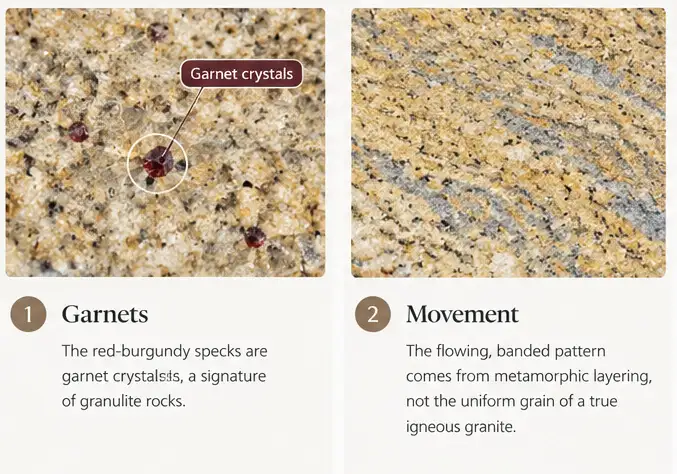
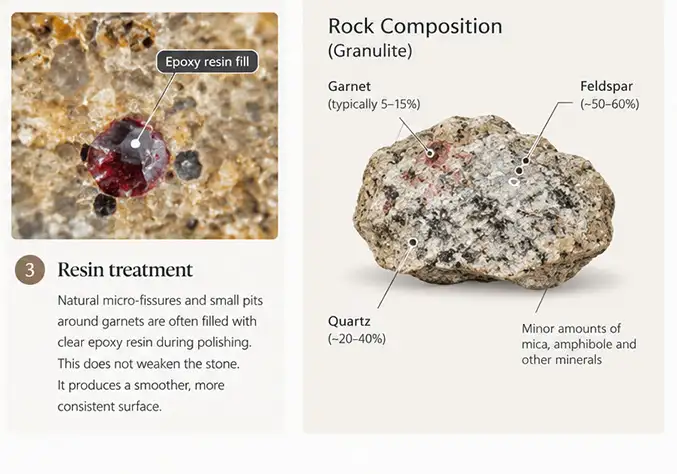
Commercially, New Kashmir Gold is sold as granite, and it performs like a hard granite in most applications. Geologically, however, it is a granulite. A granulite is a high-grade metamorphic rock formed under high temperature and moderate pressure. It is mainly made of feldspar and quartz, and it often contains garnets.
Under European standard EN 12670, the stone is classified as a granulite. This explains three features buyers notice:
● Garnets: The red-burgundy specks are garnet crystals, a signature of granulite rocks.
● Movement: The flowing, banded pattern comes from metamorphic layering, not the uniform grain of a true igneous granite.
● Resin treatment: Natural micro-fissures and small pits around garnets are often filled with clear epoxy resin during polishing. This does not weaken the stone. It produces a smoother, more consistent surface.
New Kashmir Gold vs Kashmir Gold: What Is the Difference?
| Factor | Kashmir Gold (classic) | New Kashmir Gold |
|---|---|---|
| Origin | Madurai belt, Tamil Nadu | Madurai belt, Tamil Nadu |
| Extraction period | From the mid-1980s | From the early 2000s onward |
| Base colour | Golden-yellow to beige | Golden-yellow to beige |
| Features | Grey/black flow, burgundy garnets | Grey/black flow, burgundy garnets |
| Availability | Limited from original faces | Current, regular block supply |
| Trade usage | Often used as the umbrella name | Often sold simply as “Kashmir Gold” |
Colour depth, garnet density, and vein movement vary more from quarry face to quarry face than between the two names. A “light” and a “dark” New Kashmir Gold slab can look quite different. The only reliable way to know what you will receive is to approve actual slab photos or samples from the specific lot.
Colour and Appearance
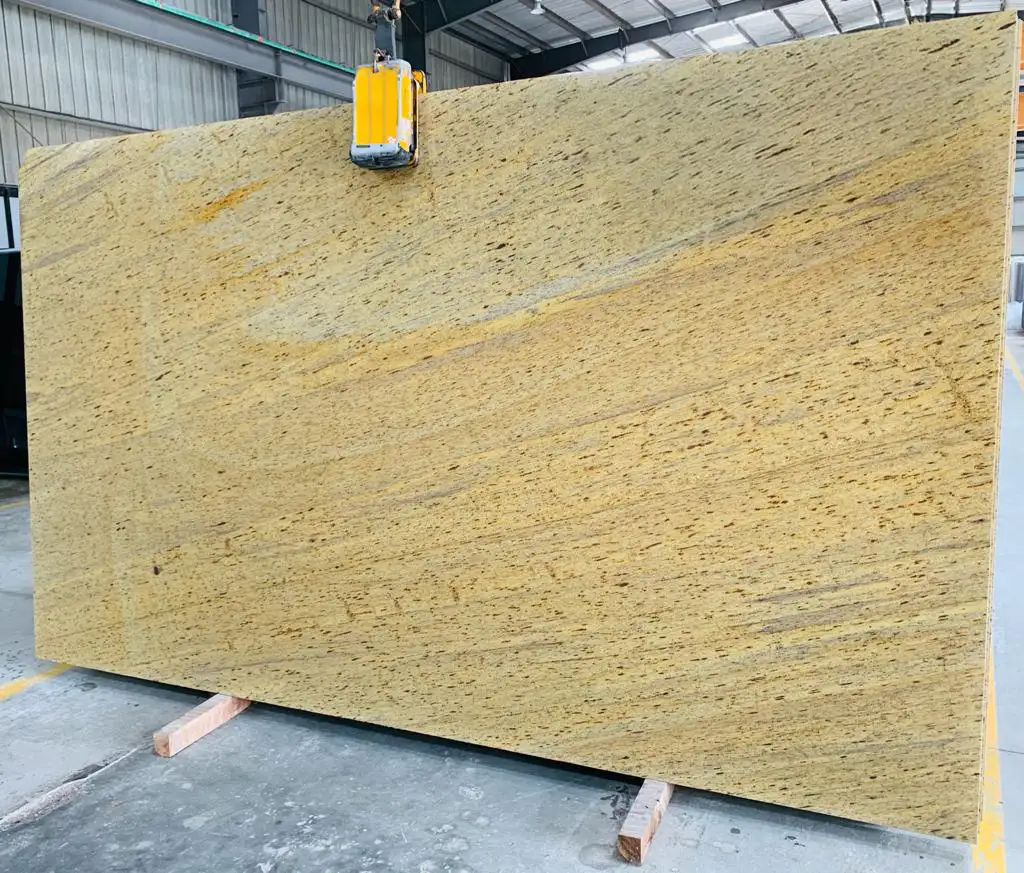
New Kashmir Gold granite shows:
● A warm base ranging from pale cream-gold to deeper honey-yellow
● Flowing grey, charcoal and black mineral bands
● Burgundy and rust-red garnet specks, sometimes clustered
● Light brown and beige tones that add depth
● A high-gloss finish on polished slabs that deepens the golden tones The stone is usually offered in light, standard and dark tones. For large projects, all slabs should come from the same block or quarry face to keep colour consistent across floors and walls.
Technical Properties of Kashmir Gold Granite
The values below are indicative ranges published for this material. Actual values vary by quarry and block. Specifiers should always request a current test report for the lot being supplied.
| Property | Indicative Value | Test Standard |
|---|---|---|
| Bulk density | Approx. 2,600–2,750 kg/m³ | EN 1936 / ASTM C97 |
| Water absorption | Approx. 0.2–0.4% | EN 13755 / ASTM C97 |
| Compressive strength | Approx. 150 MPa | EN 1926 / ASTM C170 |
| Flexural strength | Approx. 10 MPa | EN 12372 / ASTM C880 |
| Frost resistance | Frost resistant | EN 12371 |
| Mohs hardness | Approx. 6–7 | — |
What this means in practice: New Kashmir Gold is strong enough for countertops, flooring and cladding. Its water absorption is higher than dense black granites, so sealing is recommended in kitchens, bathrooms and exterior areas.
Available Finishes
● Polished: This is the most popular finish. It shows the full golden depth and garnet sparkle. Ideal for countertops, vanity tops and interior walls.
● Honed: A matte, smooth surface for a softer, contemporary look. It shows less glare but needs regular sealing.
● Leathered (brushed): A textured, satin surface that hides fingerprints and water spots. It is increasingly popular for kitchen islands.
● Flamed: A rough, slip-resistant surface for exterior paving, steps and pool surrounds. It lightens the colour noticeably.
● Sandblasted and bush-hammered: For landscaping, facades and anti-slip exterior use.
Sizes and Formats
| Format | Typical Sizes |
|---|---|
| Gangsaw slabs | 280 cm and above × 180 cm and above, 2 cm / 3 cm |
| Cutter slabs | 180–300 cm × 60–90 cm, 1.8–2 cm |
| Tiles | 30×30, 60×30, 60×60 cm; custom sizes |
| Countertops | Prefabricated or cut to drawing, 2 cm / 3 cm |
| Vanity tops | Standard or project-specific sizes |
| Cut-to-size | Steps, risers, sills, copings, skirting |
Edge profiles such as eased, bullnose, half-bullnose, bevel and ogee can be produced to specification.
Applications: Where Kashmir Gold Granite Works Best
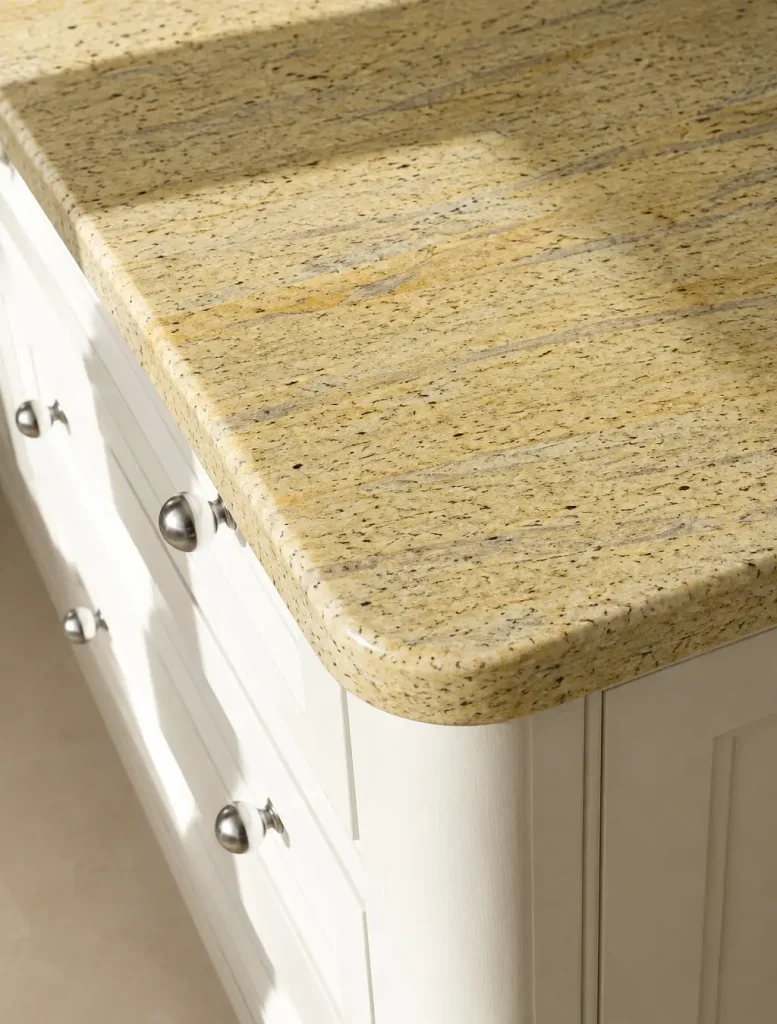
Kitchen countertops and islands: Kashmir Gold granite countertops remain a classic choice. The busy pattern hides crumbs, minor marks and water spots, and the stone handles heat and daily use well.
Bathroom vanity tops: The warm tones suit both traditional and modern bathrooms, especially with white or cream fittings.
Flooring: Suitable for residential and commercial interiors such as hotel lobbies, offices and showrooms. Use honed or leathered finishes in areas where slip resistance matters.
Wall cladding: Works for feature walls, reception backdrops and lift lobbies. Book-matched slabs create a strong visual impact.
Staircases, sills and thresholds: A durable choice for high-traffic building elements.
Exterior use: With flamed or sandblasted finishes, the stone can be used for paving, facades and pool surrounds, including in cold climates, as it is frost-resistant.
Where to take care: In exterior wet areas and around sinks, proper sealing and good installation practices are important because of the stone’s moderate absorption.
Design & Colour Pairings
New Kashmir Gold granite pairs well with the following:
● Navy, sage green & charcoal cabinets for contemporary contrast
● White, cream & ivory cabinets for a bright, classic kitchen
● Brushed brass, bronze & matte black hardware
● Cherry, oak & walnut wood for warm, traditional interiors
● Neutral beige or ivory backsplash tiles that do not compete with the pattern
How to Check Quality Before Ordering
Use this given checklist when sourcing New Kashmir Gold granite slabs:
1. Approve lot photos or samples. A small sample does not represent a full slab of this stone.
2. Confirm block consistency. For projects, request slabs from the same block or quarry face.
3. Check resin work. Resin filling should be clean & even, with no cloudy patches or lifting.
4. Inspect polish quality. A uniform, mirror-like polish across the slab indicates good processing.
5. Look for cracks & fissures. Natural lines are normal. Open cracks that pass through the slab are not.
6. Verify thickness & calibration. Measure at several points, especially for tiles.
7. Ask for test reports & certifications. Request data for the specific lot.
8. Confirm packing. Slabs should be shipped in fumigated, sea-worthy wooden crates or bundles
Kashmir Gold Granite Price: What Drives It?
Kashmir Gold granite price depends on several factors rather than one fixed rate:
● Grade: Premium or select slabs with even colour and fewer defects cost more than commercial grade.
● Slab size: Large gangsaw slabs are priced higher than cutter slabs & tiles.
● Thickness: 3 cm thickness costs more than 2 cm thickness.
● Finish: Leathered and specialist finishes may add cost over standard polish.
● Order volume: Full container loads are more cost-effective than small mixed orders.
● Incoterms: FOB, CIF and DDP pricing differ based on freight and insurance.
For accurate export pricing, share your required format, size, thickness, finish, quantity and destination port with the supplier.
Care and Maintenance
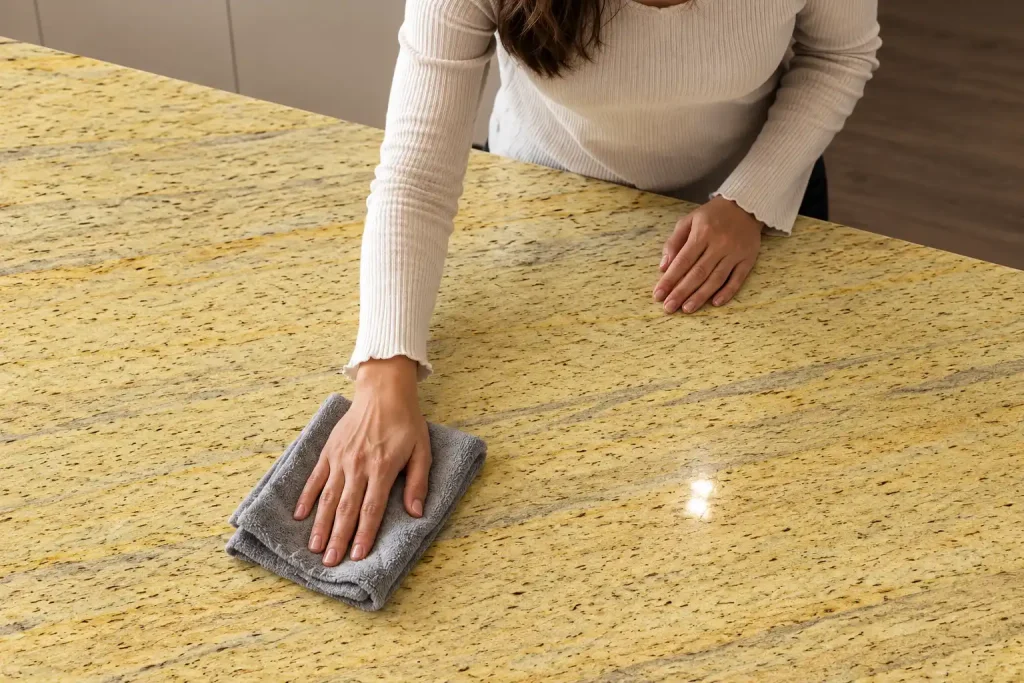
● Seal after installation and then reseal every 12 to 24 months, depending on use.
● Clean with a pH-neutral stone cleaner or mild soap & water.
● Avoid bleach, vinegar & harsh acidic or abrasive cleaners.
● Wipe spills promptly, especially oils, wine, coffee & citrus.
● Use trivets for very hot cookware as a precaution, and cutting boards to protect the polish.
● Do not over-seal. Excess sealer can leave a hazy film on the surface.
Exporting New Kashmir Gold Granite from India
India is the main global source of Kashmir Gold and New Kashmir Gold granite. Material is exported to North America, the UK, Europe, the Middle East and Australia. A typical export shipment includes:
● Slabs in fumigated wooden A-frames, crates or bundles
● Tiles and cut-to-size pieces in wooden crates with protective foam or film
● Container loading plan according to the container’s weight limit, as stone reaches weight capacity before volume
● Documents such as commercial invoice, packing list, bill of lading, certificate of origin and fumigation certificate
Why Source New Kashmir Gold Granite from Regatta Granites India
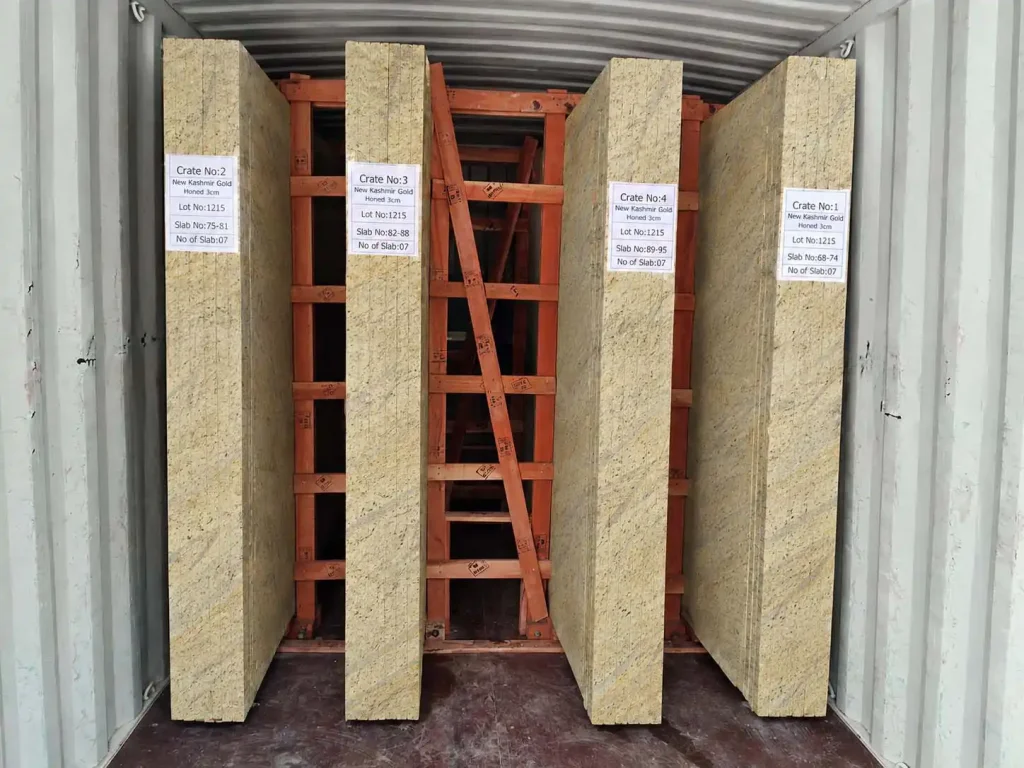
Regatta Granites India has more than 25 years of experience in manufacturing and exporting natural stone to importers, fabricators, architects, contractors and wholesalers worldwide. We select blocks carefully, process them at our facilities in Andhra Pradesh and Rajasthan, and inspect every slab before packing.
● ISO 9001:2015 and ISO 14001:2015 certified
● CE marked products
● One Star Export House recognised by the Government of India
● CAPEXIL member, D&B registered
● Slabs, tiles, countertops and cut-to-size in multiple finishes
● Lot photos, block consistency and export-grade packing for every order
Looking for New Kashmir Gold granite slabs or tiles for your next project?
Request a quote with your specifications, and our export team will share lot photos, sizes and pricing.
Frequently Asked Questions
New Kashmir Gold granite is a golden-yellow natural stone from Tamil Nadu, India, with grey and black flowing veins and burgundy garnet specks. It is the current-production variety of the classic Kashmir Gold granite.
Kashmir Gold granite is quarried in the Madurai region of Tamil Nadu, South India, mainly around Melur. It does not come from Kashmir. “Kashmir Gold” is a trade name.
Both come from the same South Indian stone belt and look very similar. New Kashmir Gold comes from quarries opened from the early 2000s onward and is the variety most widely available today. Colour differences depend more on the specific quarry face and block than on the name.
It is sold and used as granite. Geologically, it is a granulite, a hard metamorphic rock with garnets, classified as such under EN 12670.
Yes. It is durable, heat-resistant, and its pattern hides everyday marks well. Seal it properly, as its absorption is higher than dense dark granites.
Yes. Sealing after installation and resealing every one to two years helps prevent staining, especially in kitchens & bathrooms.
Yes. It is frost-resistant and suitable for exterior paving, cladding and steps when supplied in flamed, sandblasted or other textured finishes.
Polished, honed, leathered, flamed, brushed, sandblasted and bush-hammered finishes are available.
Slabs are usually 2 cm and 3 cm thick. Tiles are generally 1 to 2 cm, and custom thicknesses are available for steps and cladding.
Yes, especially in warm, traditional and transitional interiors. Leathered and honed finishes paired with modern cabinet colours give it a contemporary look.