Granite Monument Inspection: How Every Stone Is Checked Before It Ships

Checked Before It Ships Granite monument inspection is a step-by-step quality check process through which a memorial passes before it leaves the factory: the raw block is screened for hidden flaws, the cut pieces are squared to within a couple of millimeters, the polish is judged by gloss meter and by eye, and every letter is proofed against the approved artwork. Skip one of those and the stone is a write-off — a monument only gets made once, and there’s no second chance to fix a name spelled wrong or a face that won’t sit flat on its base. The rest of this piece walks through how each of those checks is actually done on the floor.
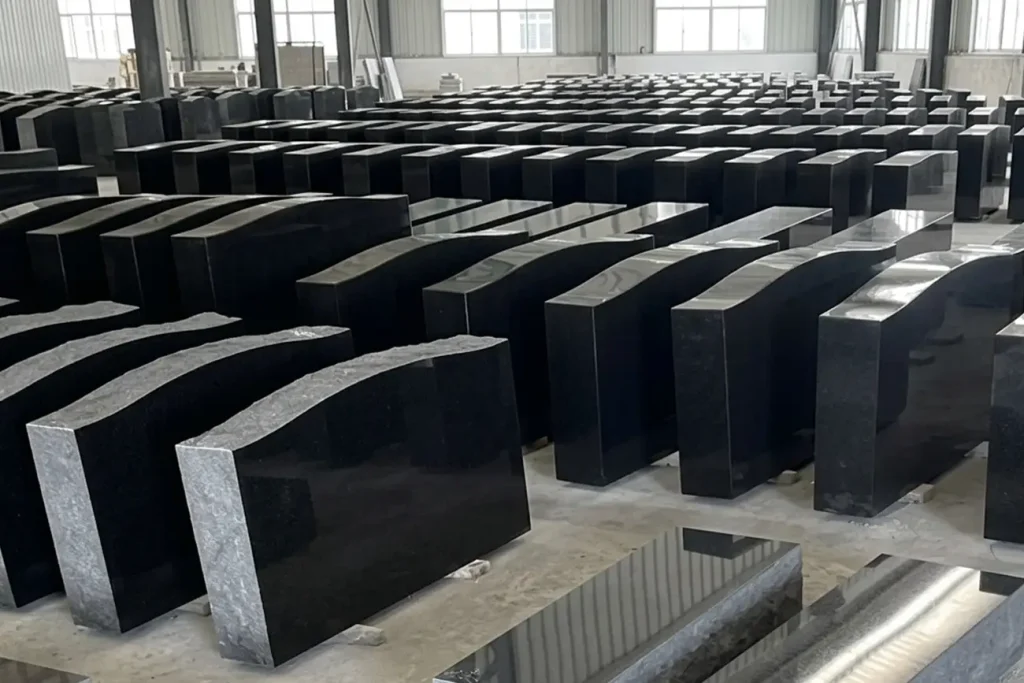
People assume granite is forgiving because it’s hard. It isn’t. Granite sits at roughly 6 to 7 on the Mohs scale and is made mostly of quartz, feldspar and mica, which is exactly why a granite monument lasts outdoors for generations where marble would dull and sandstone would crumble. But that same hardness means a flaw can’t be sanded out late in the process the way it might be in a softer stone. A fissure you miss in the block turns into a crack on the truck. So we catch things early, or we don’t catch them at all.
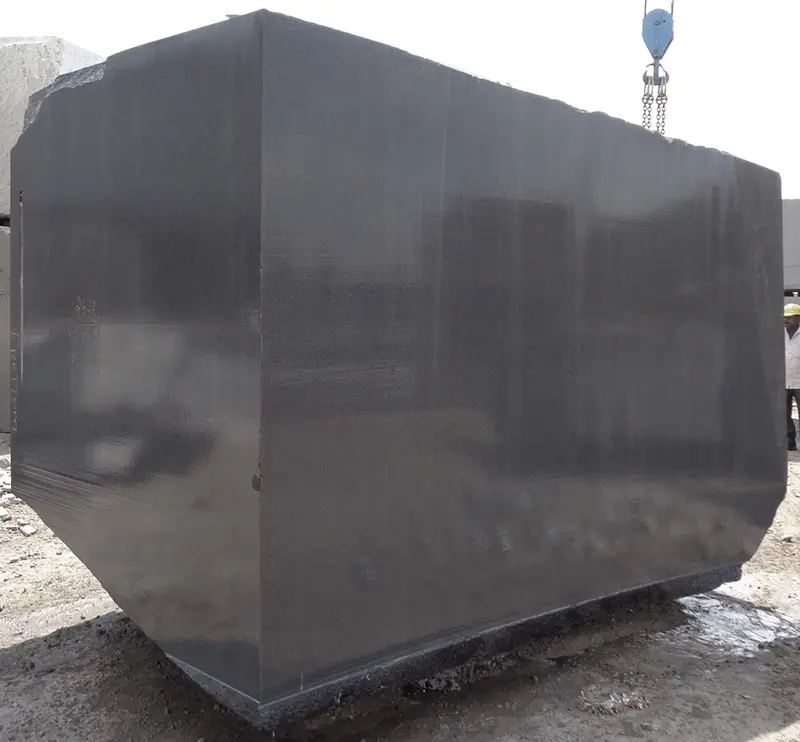
The process starts with the block, not the polish
Before anything is cut, the block gets looked over and listened to. A clean granite block rings when you tap it. A dull thud usually means a hidden seam, and those slabs are discarded. We’re also watching for iron content that’ll bleed rust-coloured stains years later, for colour veins that don’t match the order, and for the hairline fissures that love to open up under a saw.
We turn down a fair share of stone at this stage. It feels wasteful in the moment, but a bad block that gets through costs far more later, usually as breakage somewhere between our yard and a cemetery on the other side of the world.
Dimensional verification
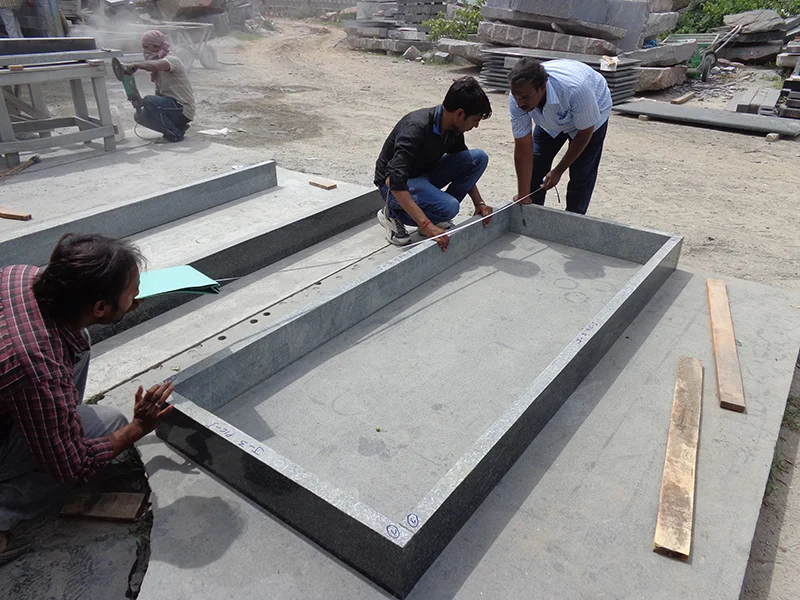
We measure length, width and thickness on every component against the drawing, and then we check the part that people forget — the thickness of the long horizontal bars has to agree with the verticals, or the whole assembly racks out of true. The trick we lean on is measuring both diagonals across a face. If the two diagonals come out equal, the corners are genuinely 90 degrees. If they don’t, something’s off even when each individual edge looks fine to the eye. We chase that down to a couple of millimeters before the piece moves on.
For reference, here’s roughly where our acceptance bands sit, and the material standards behind them:
| What we’re checking | Standard/band |
| Length & width | within about ±1.5 mm |
| Squareness (diagonal difference) | under ~2 mm |
| Water absorption | ASTM C97, ≤ 0.4% |
| Compressive strength | ASTM C170, ≥ 131 MPa |
| Flexural strength | ASTM C880, ≥ 8.27 MPa |
These figures come from ASTM C615, the dimension-stone specification for granite. Confirming the raw block meets them is the first stage of inspection—before any cutting begins.
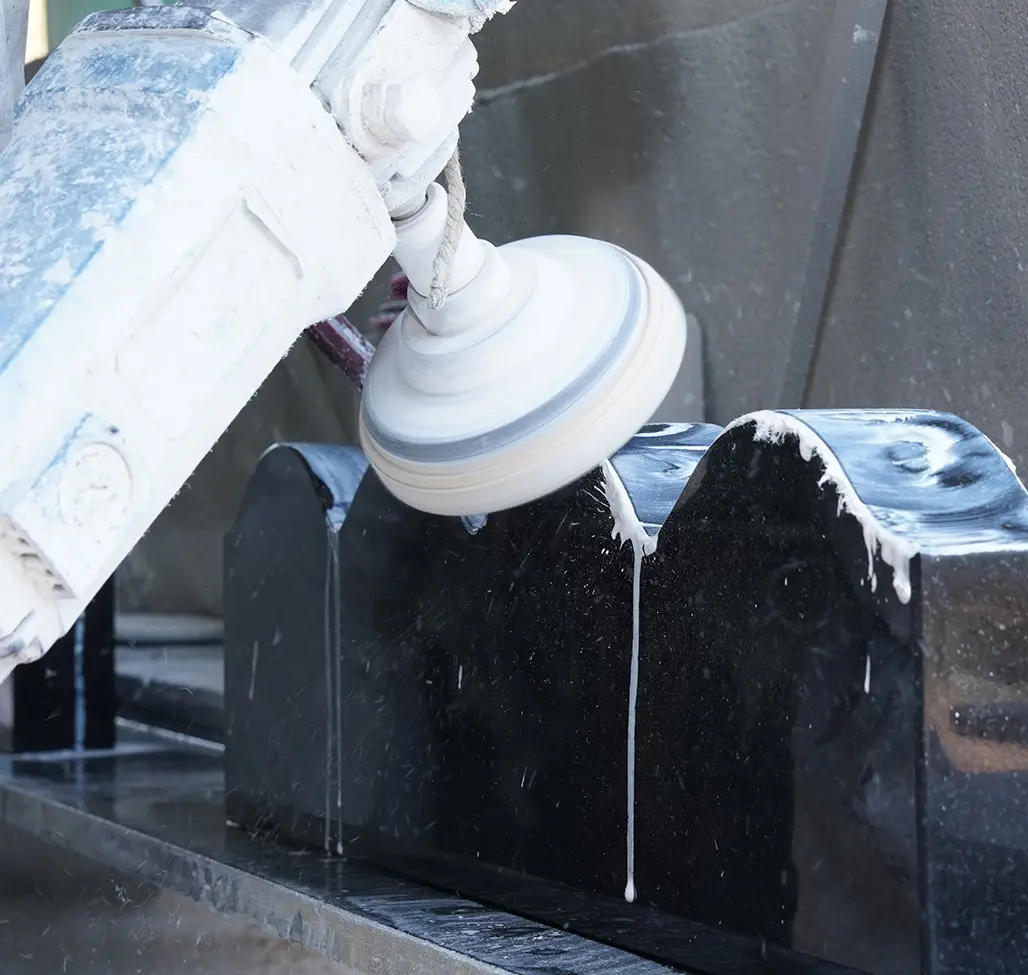
Granite monument polish quality
The granite monument’s polish quality is measured with a gloss meter, which reports a Gloss Unit (GU) value at a fixed 60-degree angle of incidence. A true mirror-polished granite surface typically reads 85 GU or higher, while honed surfaces fall in the 10–40 GU range. Inspectors combine the meter reading with a visual test: a sharp, undistorted reflection of an overhead reference indicates that the surface has been progressively abraded and buffed through the full grit sequence, with no skipped stages. A high-quality mirror-like polish is not just about aesthetics—it helps seal the overall surface, safeguarding it against moisture ingress & biological staining that may occur over the monument’s service life.
The lettering is the part you can’t fix
Everything up to here is craft. The engraving is the part that carries the actual meaning, and it’s the least forgiving check we do. Names, dates, the layout, the depth of the cut, the spacing — we go over it line by line again and again as per the approved artwork. Sandblasted or laser-etched, the letters need consistent depth and clean edges. A flawless piece of granite monument loses all its value if the dates, names, or spelling are wrong. So this stage gets two sets of eyes, not one.
Frequently asked questions:
– What’s checked first in a granite monument inspection?
The raw block & slabs are checked before any cutting. We screen them for hidden seams, iron content and colour veins, because an internal flaw can’t be fixed once the stone is finished — it only gets more expensive.
– How do you know a granite monument is truly square?
We measure both diagonals across a face. Equal diagonals mean genuine right-angle corners, even when each edge looks fine on its own.
– What counts as a good polish on a granite tombstone?
A mirror polish reads up in the high 80s on a gloss meter, but the real test is the reflection — it should be sharp and undistorted, with no cloudy or wavy patches.
– Which standard applies to granite used for monuments?
ASTM C615 is the main one, covering strength, density and absorption, with C97, C99, C170 and C880 behind the individual figures.
How disciplined inspection protects the buyer
A monument is purchased once and expected to last a lifetime, so the cost of a defect is not a return—it is a broken commitment to a grieving family. Rigorous inspection & quality checks honor that responsibility, protect the exporter’s reputation, and reduce in-transit breakage caused by undetected fissures. Because Regatta Granites India controls quarrying, manufacturing, and inspection in-house, it can hold competitive pricing without compromising on any structural and surface standards as mentioned above.
Explore the full range of granite monuments and tombstones here. We’re happy to send a specification sheet for anything you’re considering.