Different Types of Kitchen Countertop To Choose From

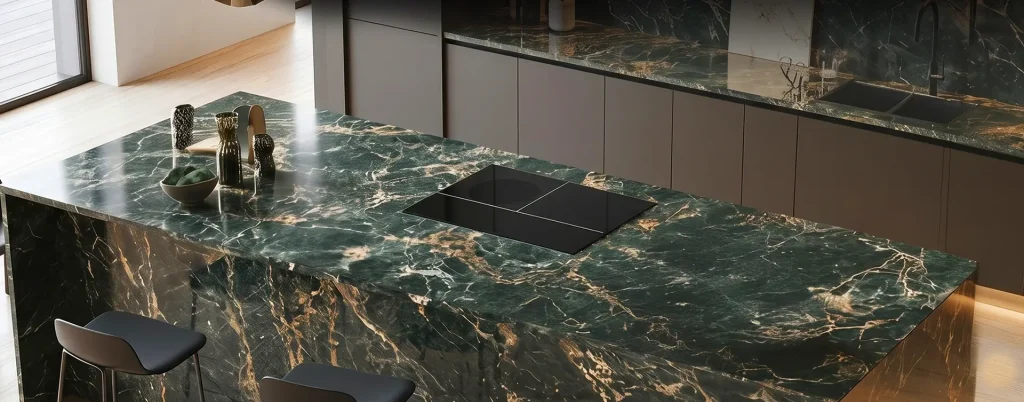
The kitchen is one of the most-used rooms in any home, and the countertop is the single surface that takes the most daily wear. Choosing the right material affects how much upkeep the kitchen needs, how long it lasts, and how much of the renovation budget it consumes.
Quick Answer: Quartz & granite are the most popular choices because they offer balanced durability with low maintenance. Marble offers the most classic look but also needs the most care. Butcher block & laminate are the most budget-friendly options. The right choice depends on how much sealing & cleaning a person is willing to do, and how much heat and scratch resistance you require.
Countertop Comparison at a Glance
| Material | Durability | Maintenance | Heat Resistance | Relative Cost |
| Quartz (engineered) | Very high | Low (no sealing) | Moderate | $$$ |
| Granite | Very high | Moderate (annual sealing) | High | $$$ |
| Marble | Low-moderate | High (frequent sealing) | High | $$$$ |
| Quartzite | High | Moderate (frequent sealing) | Moderate-hig h | $$$ |
| Butcher block | Moderate | Moderate (oiling) | Low | $$ |
| Laminate | Low-moderate | Low | Low | $ |
| Soapstone | Moderate | Moderate (mineral oil) | Very high | $$$ |
| Stainless steel | High | Low | Very high | $$$ |
| Concrete | High | Moderate (resealing) | High | $$$ |
| Solid surface (e.g., Corian) | Moderate | Low | Low-moderat e | $$ |
| Bamboo | Moderate | Moderate (sealing) | Low | $$ |
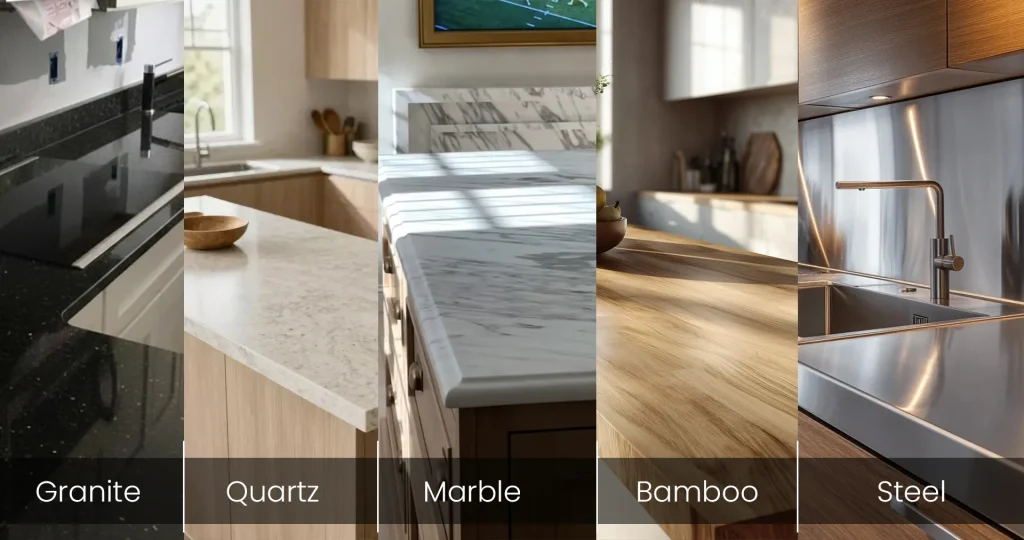
1. Quartz (Engineered Stone)
Quartz countertops are made from roughly 90-95% ground quartz crystals bound with resin, which makes them non-porous straight out of the factory. That means no sealing, ever, and strong resistance to stains from wine, coffee, and citrus.
- Durability: Very high; resists scratches and chips better than most natural stone.
- Maintenance: Lowest of any stone-look option — soap and water are usually enough.
- Heat resistance: Good for everyday use, but the resin binder can scorch under a hot pan, so trivets are still recommended.
- Look: Because it’s engineered, quartz comes in the widest range of consistent colors and patterns, including veining that mimics marble.
- Best for: Homeowners who want a stone look without the sealing routine.
2. Quartzite
Quartzite is a natural stone, not to be confused with engineered quartz. It forms when sandstone is transformed by heat & pressure, giving it marble-like veining with a harder surface.
- Durability: Harder & less prone to chipping than marble, though still needs care.
- Maintenance: Requires sealing, typically similar in frequency to granite.
- Look: Usually white or grey with light to dramatic veining and a subtle sparkle from quartz crystals.
- Best for: Homeowners who want the marble look with better scratch resistance..
3. Marble
Marble is the classic choice for a bright, elegant kitchen, and it stays noticeably cool to the touch — a plus for bakers who roll out dough.
- Durability: The softest and most porous of the popular natural stones; scratches and chips are common over time and become part of its character.
- Maintenance: Highest of any material on this list. Spills from wine, citrus, and oil need to be wiped up immediately to prevent etching, and the surface needs frequent sealing.
- Finish options: Polished marble is glossy and more stain-resistant; honed marble has a matte finish that hides etching and scratches more easily.
- Best for: Homeowners prioritizing classic looks over low maintenance, often paired with a more durable material at the cooking zone.
4. Granite
Granite is a natural stone cut from quarried slabs, so every countertop has a one-of-a-kind pattern.
- Durability: One of the most heat- and scratch-resistant materials available; hot pans can go directly on it.
- Maintenance: Because granite is porous, it needs sealing roughly every 6-12 months to resist stains.
- Look: Wide range of color options, from uniform speckled patterns to dramatic swirls & veins.
- Best for: Cooks who want a durable, heat-proof surface and don’t mind an annual sealing routine
5. Butcher Block (Wood)
There’s something about wood on a counter that just makes a kitchen feel lived-in. It goes with almost anything — modern, farmhouse, doesn’t matter.
- Durability: Won’t crack on you. But leave a knife resting on it wrong or set down something hot, and yeah, you’ll see it.
- Maintenance: Oil it. Seriously, don’t skip this — skip it and it dries out, maybe warps. Good news: scratches sand right out, so it’s forgiving in that sense.
- Best for: An island. A baking station. People who don’t mind a little upkeep in exchange for character.
6. Bamboo
Technically grass, not wood — which is part of why it’s the more sustainable pick here.
- Durability: Tougher than regular wood counters, but heat and sharp knives still get the better of it.
- Maintenance: Seal it regularly. It’s porous, so skip that and it’ll stain.
- Look: Strand-woven, end-grain, vertical or horizontal grain — pick your pattern, they all look pretty different.
- Best for: Anyone who wants the wood look but with a bit more backbone.
7. Concrete
Poured or precast — either way, you can basically make it whatever you want. Color, shape, embedded tile, glass, you name it.
- Durability: Solid once it’s cured. Hairline cracks can show up eventually, though — that’s just concrete being concrete.
- Maintenance: It’s porous, so it requires resealing now & then, or it’ll stain.
- Best for: Anyone who wants something genuinely custom, not off a shelf.
8. Stainless Steel
Restaurant-kitchen energy, basically. That’s the whole appeal.
- Durability: Heat, stains — doesn’t care. Won’t crack or chip either.
- Maintenance: Technically low-maintenance, but be honest with yourself: scratches, dents, and fingerprints show up constantly, so you’ll be wiping it more than you think.
- Best for: People who cook a lot and care more about hygiene than a soft, warm look.
9. Laminate
Nobody’s dream countertop, but it does the job for a fraction of the cost. Paper and resin, pressed over particleboard — that’s really all it is.
- Durability: Scratches. Burns. Chips if you’re not careful. And once it’s damaged? That’s it, no fixing it.
- Maintenance: This is where it wins — wipe it, done. No sealing, no babying it.
- Look: Honestly, some of the wood-grain and stone patterns fool people now.
- Best for: tight budgets, rentals, or a kitchen you’re renovating on a deadline.
10. Soapstone
Old material, still around for good reason — that matte, almost soft-looking finish is hard to fake
- Durability: Non-porous, so stains and heat basically bounce off it. The catch — it’s soft.
- Dents and scratches easier than you’d think for a stone.
- Maintenance: Mineral oil, regularly. It deepens the color and scratches sort of disappear into it. No sealing though, liquids don’t soak in anyway.
- Best for: Farmhouse kitchens, or anywhere near the stove where heat’s a real concern.
11. Solid Surface (Corian, etc.)
Synthetic, seamless — sink and counter can be one continuous piece with no seams at all.
- Durability: Handles water and stains without a problem. Heat’s the weak spot — leave a hot pan too long (past roughly 212°F) and you’ll regret it.
- Maintenance: Low maintenance. Scratches get buffed out by a pro, and since nothing soaks in, sealing’s a non-issue.
- Best for: People who want that seamless look without dealing with stone’s sealing routine.
Frequently Asked Questions
Q. What is the lowest-maintenance countertop?
A. Engineered quartz requires the least upkeep because it’s non-porous & never needs sealing, unlike granite, marble, quartzite, soapstone, concrete, and bamboo.
Q. Is quartz better than granite?
A. Quartz needs less maintenance since it never requires sealing as compared to granite, while granite offers slightly better heat resistance and a fully natural look. Both are similarly durable and priced in a comparable range.
Q. What is the most durable kitchen countertop material?
A. Granite & engineered quartz are generally considered the most durable among the available options on the market; both offer better scratch, heat, and daily wear resistance than softer stones like marble.
Q. What countertop is best for a busy family kitchen?
A. Quartz, granite, and stainless steel tend to hold up best to daily cooking, spills, and heat in high-traffic kitchens.
Q. What is the cheapest kitchen countertop option?
A. Laminate is typically the most affordable option, followed by butcher block and solid surface.
Final Thoughts
There’s no single “best” countertop — the right material depends on how the kitchen gets used.Cooks who lean on hot pans and sharp knives tend to do best with granite, quartz, or stainless steel. Homeowners chasing a classic look who don’t mind extra care often gravitate toward marble. And anyone renovating on a budget can still get a durable, attractive surface with laminate or butcher block.